House Clearance in Watford for homes, flats and mixed contents

House clearance in Watford should be straightforward, respectful and organised around what needs to leave the property, what can stay, and what should be handled separately. We provide a practical service for clearing household contents, from single rooms and loft spaces to full properties, including furniture, general household items and bulky pieces that are awkward to move. The aim is simple: help you regain a usable space with clear communication and sensible planning.
If you are clearing a property after a move, tenancy change, refurbishment or family change, the work often involves more than removing a few items. It can include sorting through stored belongings, separating reusable items from waste, and working carefully around access limits, stairways and fixed features. House clearance services are most useful when you want the job handled in a structured way rather than trying to manage each load alone.
The service can be scaled to suit different property types and contents levels, including partial clearances where only selected rooms or categories need attention. We also deal with items that are best removed on their own, such as old sofas, wardrobes or other heavy furniture, so that the overall clearance is not slowed down by difficult individual pieces. For broader properties, the work can be planned in stages to keep the process orderly and manageable. Please get in touch for a quotation.
Clearance for whole properties and selected rooms
A house clearance is rarely just one type of task. Some customers need a complete clearance of every room, while others only need certain areas tackled, such as a spare room, airing cupboard, box room or downstairs storage space. We can focus on the rooms that matter most and leave the rest untouched, which is useful when you want to keep important belongings in place and remove only the items that are no longer needed.
That flexibility is often important in homes with mixed contents. You may have furniture that is still serviceable, general bric-a-brac, paper, textiles and larger items that need extra handling. Home clearance work can be arranged around those different categories so the removal process stays efficient and does not become a catch-all for everything in the property. Please ask for a quotation if you want to discuss the scope.
What can be included in a typical clearance
Typical work may cover wardrobes, beds, chests of drawers, shelving, tables, chairs, boxes of household items, ornaments, kitchen contents and other domestic pieces that have built up over time. When a property contains a mixture of useful and unwanted items, we can keep the focus on what actually needs moving rather than treating the entire house as a single undifferentiated job. That approach helps keep the clearance practical and measured.
Furniture, bulky items and awkward access
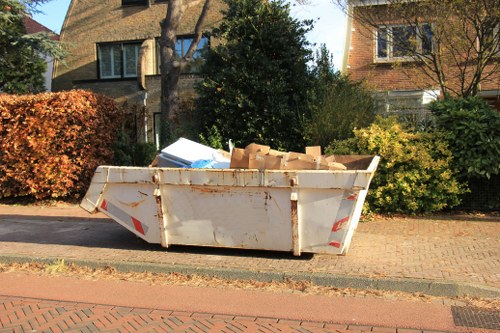
Heavy furniture often shapes the whole clearance because it can affect access, lifting, and the time needed on site. Large wardrobes, sofa units, beds, sideboards and similar pieces may need to be taken apart or moved carefully through tight hallways and stairwells. We can handle furniture clearance as part of a wider house clearance or as a focused job where the main issue is removing large items safely and sensibly.
Some properties contain older items that are too large for normal handling, while others have several smaller pieces that are awkward simply because of the route out of the property. Furniture clearance is useful when the furniture is the main obstacle and you want a clear, direct removal plan. It can also help when furniture needs to be separated from other household contents before the rest of the property is cleared.
For certain types of items, the practical question is not just whether they can be removed, but how they should be removed without causing avoidable disruption. That may mean planning the order of work, protecting surfaces where needed and deciding which items are easiest to move first. The result is a clearance that feels controlled rather than rushed, with less chance of avoidable difficulty during the removal.
Lofts, garages and storage areas
Stored items often create the biggest volume in a house clearance, especially when the property includes a loft, garage or other catch-all storage space. These areas tend to contain a mix of old boxes, broken items, seasonal goods and belongings that have not been sorted for years. Clearing them requires patience and a sensible sequence, because the contents may be stacked, dusty or difficult to reach.
Loft clearance work usually needs extra care because access can be narrow and the contents may be fragile or unstable. Garages can be different: they often hold tools, household overflow, sports items, old furniture and miscellaneous waste in one place. A targeted approach allows these spaces to be emptied without disturbing the rest of the property more than necessary.
Where a property has multiple storage zones, it can be helpful to decide in advance which area should be tackled first. That may depend on access, the amount of clutter, or whether one space contains items that need to be separated and kept. The job is then easier to organise and the end result is a cleaner, more usable property overall.
Garden, outdoor and mixed waste items
Some house clearances include outdoor spaces as well as the rooms inside the property. Sheds, patios, front drives and garden corners can accumulate plant pots, broken furniture, old timber, general garden waste and other unwanted materials. Clearing those items at the same time as the house contents can be more practical than dealing with them separately, especially when access is already being managed on site.
Garden clearance can be arranged where outdoor clutter has become difficult to manage or where the outside area is part of the same wider change. It may also be helpful if the house itself is being cleared for sale, lettings or refurbishment and the exterior needs to be left in a tidy state too. That makes the property easier to inspect and easier to hand over.
Not every clearance is limited to one room or one category. A mixed job might combine household contents, outside items and a few bulky pieces that do not fit neatly into a single group. In those situations, the work is best planned so each type of item is handled in the right order, rather than being bundled together without a clear process. Clear planning helps make the task more manageable from start to finish.
Household clearances for moves, tenancies and changed circumstances

Many customers need a house clearance because the property is changing hands, being re-let or prepared for refurbishment. In those situations, the main requirement is usually to remove the remaining contents cleanly and leave the property in a usable condition for whatever happens next. That can involve one-off removals, full clearances, or a staged approach where the most urgent rooms are dealt with first.
Flat clearance can be especially useful where access is shared, space is limited or contents need to be moved carefully through communal areas. Flats often contain the same kinds of household items as larger homes, but the logistics are different, so it helps to use a service that understands the practical effect of stairwells, lifts and tighter internal layouts. This can also apply when a property is part-furnished.
When a house clearance is being arranged, two points are worth preparing in a simple way: first, a rough note of what stays and what goes; second, any access details that affect the work, such as parking, key collection or steps. That information helps keep the job organised without turning the enquiry into a long exercise. A few clear details are often enough to shape a sensible quotation and plan.
Business and office clearance alongside domestic work
Not every clearance is purely domestic. Some customers need office furniture, filing items, desks, chairs or mixed contents removed from a workplace at the same time as domestic spaces are being cleared. We can support that kind of transition when the job is mainly about removing redundant items and restoring order to the property or premises. The work is approached with the same focus on access, sorting and practical removal.
Office clearance is useful when furniture and work-related items need to be removed in an organised way rather than simply taken away in a rush. If the contents are mainly general waste rather than furniture, business waste removal may be a better fit. Choosing the right type of clearance helps the task stay aligned with the actual material on site.
For property owners and landlords, the value of a well-planned clearance is that it reduces uncertainty. You can identify the rooms, items and access conditions that matter, then decide what level of removal is appropriate. If the job includes both domestic and work-related contents, it can still be handled as one coordinated clearance so long as the scope is understood at the outset.
Sorting, removal order and practical decisions
Good clearance work is often about order rather than speed. Larger items may need to come out first so that smaller pieces can be reached, or the reverse may be more sensible if the property contains fragile belongings that should be separated early. The right sequence depends on the contents, the route out of the property and whether certain items need to be kept aside during the process.
Waste removal can be relevant where the contents are mainly loose rubbish, bagged materials or mixed waste that does not form a conventional furniture load. For properties with a high volume of old items, a combination of clearance and waste removal may be the most practical way to complete the job without overcomplicating it. The key is choosing the approach that matches the material on site.
Where suitable, items can be grouped before removal so that the work proceeds more smoothly. That might mean separating paperwork from furniture, or isolating items that are still useful from those that are ready to go. Keeping the scope clear helps avoid confusion and allows the job to be completed in a straightforward way. Please contact us if you would like to request a quotation.
Planning your quotation and understanding the factors involved
Quotation requests are usually most useful when they reflect the real shape of the clearance. The main factors are the amount of material, the type of items involved, how easy it is to reach them and whether the job is a single room, a whole property or a mix of spaces. A property with bulky furniture, storage clutter and awkward access will generally need a different plan from a simple one-room clearance.
Pricing and quotes is the most relevant page when you want to understand how a clearance request can be assessed before work begins. The aim is not to overstate what is involved, but to make sure the enquiry reflects the actual contents and any conditions that may affect the removal. If there are items you are unsure about, they can usually be described broadly rather than catalogued item by item.
It is often enough to provide a short description of the property, the main items that need removing and any constraints such as narrow access or restricted parking. That keeps the quotation process practical and avoids unnecessary back-and-forth. If you are ready to move ahead, ask for a quotation and we can discuss the most suitable way to approach the clearance.
About Watford

Watford is a large town in Hertfordshire, positioned to the north-west of London and shaped by a long history of movement, trade and suburban growth. Its earlier development was linked to routes through the area and to the later arrival of the Grand Junction Canal and the railways, both of which helped the town expand beyond its older centre. The present-day town combines a busy commercial core with residential districts that reflect different periods of growth, from older streets near the centre to later suburban estates on the outskirts. Watford High Street and the surrounding shopping areas remain key parts of the town’s identity, while the town centre is also known for the Watford Palace Theatre, a longstanding cultural venue with a varied programme. Cassiobury Park is one of the best-known open spaces, with expansive parkland, woodland walks and formal landscaping that reaches back to the estate of Cassiobury House. The nearby River Colne and the canal corridors add further landscape interest, and the town’s built environment includes civic buildings, places of worship, converted commercial premises and post-war development. Watford’s position close to the capital has made it a place of constant change, yet it still retains recognisable historic layers, a strong local centre and a varied urban character that can be read through its streets, parks and public buildings.
Furniture disposal, recycling and final checks
Some clearances end with a final pass through the property to make sure nothing important has been overlooked. That can be especially useful where furniture is being removed from several rooms, or where a mixture of large and small items has been handled in stages. A careful finish gives the property a more settled result and helps the customer see exactly what has been completed.
Furniture disposal is relevant when individual items are no longer wanted and need to be taken away as part of the wider job. If you are interested in how unwanted items are handled after collection, recycling and sustainability explains the approach in more detail. Both pages can help you understand the journey from removal to final handling without assuming every item belongs in the same category.
Before the work concludes, it is sensible to check any belongings you intend to keep, especially small items that may be stored inside furniture or tucked behind larger pieces. That final review helps avoid confusion and gives confidence that the clearance has covered the agreed scope. If you need the job arranged, please get in touch for a quotation.
Why a structured clearance approach helps

A structured house clearance is usually easier to manage because it respects the different types of item found in a home. Furniture, storage contents, loose household items and outdoor materials all behave differently when they are being removed, so it makes sense to deal with them in a way that reflects their shape and size. That approach is more orderly and avoids turning the job into a vague uplift of everything at once.
Where needed, we can also discuss supporting matters such as insurance and safety and the practical steps that go with a straightforward, controlled clearance. Those details matter when a property contains heavier items, awkward access or a mixture of items that need separating carefully. For households or premises with a more complex layout, the right sequence and the right handling are often just as important as the removal itself.
Whether you need a full property cleared or only selected spaces dealt with, the important thing is to match the work to the contents. That keeps the process understandable from the outset and helps the final result feel settled rather than piecemeal. If you are planning a clearance in Watford, ask for a quotation and we can help you take the next step.